

China Top 10 Mobile Generator Suppliers for Global Buyers
China’s Mobile Generator industry is expanding as construction, data centers, healthcare, mining, and emergency services demand dependable temporary power. Grand View Research estimates that the global portable generator market will continue growing through 2030, driven by outages, infrastructure investment, and remote operations. MarketsandMarkets also identifies rental fleets, hybrid systems, and cleaner fuel technologies as major industry trends.
The opportunity is substantial.
However, market figures vary because researchers define “mobile generator” differently. Some include small trailer units, while others count industrial generator sets above 500 kVA. This limitation deserves attention when comparing suppliers.
Fatih Birol, Executive Director of the International Energy Agency, defines energy security as “the uninterrupted availability of energy sources at an affordable price.” His statement explains why buyers examine more than purchase cost. They also assess fuel efficiency, load stability, service response, emissions performance, and spare-parts availability.
China has become an important manufacturing base for these requirements. Its leading suppliers offer diesel, gas, hybrid, and battery-supported Mobile Generator systems. Some factories provide compact 20 kVA units for outdoor work. Others produce containerized systems exceeding 2,000 kVA for industrial sites.
Yet a polished brochure is not enough.
Global buyers should verify factory certifications, engine origin, acoustic ratings, testing records, and warranty coverage. They should also request references from projects operating in similar climates. A supplier may perform well in a temperate warehouse but struggle in high heat, dust, or coastal humidity.
This guide reviews China’s top ten Mobile Generator suppliers for international buyers. It focuses on manufacturing capability, product range, export experience, customization, after-sales support, and documented reliability. The ranking is useful, but it should support due diligence rather than replace it.
China’s Mobile Generator Market and Its Role in Global Power Supply
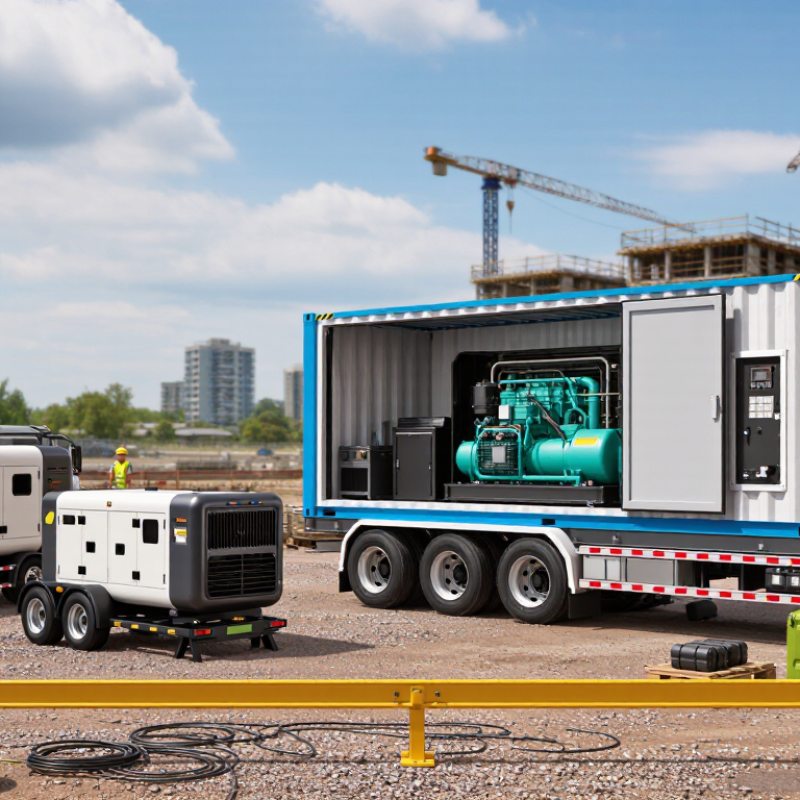
China’s mobile generator market has become an important part of global power supply. Manufacturers serve construction sites, outdoor events, farms, mines, and emergency facilities. Their equipment commonly combines diesel engines, alternators, control panels, and trailer frames. Power ratings range from compact units to large systems supporting temporary microgrids. In field inspections, buyers should examine welding quality, cable protection, grounding points, and enclosure ventilation. Small details matter.
For global users, mobile generators offer flexible power where grid access is weak or delayed. Ports, rural clinics, warehouses, and road projects often need dependable electricity within hours. Fuel tanks, weatherproof canopies, and remote monitoring can improve daily operation. However, catalog figures may hide practical limitations. A claimed runtime can change with temperature, load level, fuel quality, and maintenance habits. That gap deserves questions.
When comparing China’s top ten mobile generator suppliers, buyers should assess testing procedures, documentation, and after-sales support. Ask for load-bank test reports, noise data, emissions information, and clear warranty terms. Confirm spare-parts availability before signing a contract. Independent inspection can reveal vibration, uneven assembly, or weak control-panel labeling. I would not choose only by price. Local service response often matters more than a small discount, especially when a generator powers refrigeration or medical equipment. Some quotations still prioritize impressive specifications over repairability, and that remains a point buyers should examine carefully.
How to Evaluate China’s Mobile Generator Suppliers
Evaluating mobile generator suppliers requires more than comparing online prices. Check whether the factory builds the complete unit or only assembles imported parts. Request business licenses, production records, and recent export references. A reliable supplier should explain engine options, alternator ratings, fuel consumption, noise control, and trailer specifications clearly. Vague answers deserve caution.
Ask for test evidence under realistic loads. A proper report should show voltage stability, frequency performance, starting behavior, and shutdown protection. If possible, arrange a live video inspection or visit the production site. Examine welding quality, cable labeling, fuel-tank sealing, tire condition, and emergency-stop access. Small details matter. They often reveal process discipline.
Compliance documents should match the destination market, not just display general certificates. Confirm manuals, spare-parts support, warranty terms, and response times in writing. Clarify whether replacement components remain available after the purchase. A low quotation may exclude transport equipment, testing, or technical support. That can become expensive later. One imperfect but important point: even a careful evaluation cannot predict every field failure. Maintain an inspection plan before shipment, record acceptance criteria, and use an independent tester when the order is substantial. Supplier promises are useful, but documented performance is stronger.
Profiles of China’s Top 10 Mobile Generator Suppliers
This profile list focuses on ten Chinese mobile generator suppliers often considered by international purchasing teams. Selection should reflect more than factory size. I weigh engine integration, alternator options, enclosure quality, emissions documentation, and after-sales response.
The first supplier profile represents a large-volume manufacturer with automated frame welding and broad diesel ranges. The second emphasizes trailer-mounted units for construction sites, with reinforced axles and lockable control panels. The third focuses on silent enclosures, using layered insulation and accessible service doors. The fourth serves rental fleets, offering hour meters, quick-drain points, and standardized replacement parts.
The fifth profile is a compact-generator specialist for farms, workshops, and backup rooms. Its strength is practical packaging. The sixth combines generator assembly with remote monitoring, though connectivity quality can vary by region. That limitation deserves attention.
The seventh supplies high-output mobile sets for events and temporary facilities. Engine cooling, cable routing, and noise control matter greatly in these applications. The eighth profile highlights hybrid-ready systems that can coordinate with battery storage. This technology is promising, but local technicians may need extra training.
The ninth supplier is export-oriented, with multilingual manuals, spare-parts planning, and documented factory testing. The tenth competes through customization, adapting fuel tanks, outlets, and trailer dimensions to project requirements.
Real purchasing work begins beyond the brochure. Request load-bank reports, serial-number traceability, warranty terms, and independent inspection access. I would also test cold starts and emergency-stop functions before shipment. Some suppliers respond quickly during sales discussions, yet slower service can appear after delivery. That gap is easy to overlook. Buyers should compare measured performance, applicable standards, and service commitments, not only rated power or attractive pricing.
Comparing Generator Types, Capacities, Features, and Service
Global buyers comparing China’s top ten mobile generator suppliers should start with application, not catalog rankings. Diesel sets remain common for construction, emergency backup, and remote work. Gasoline models suit lighter, shorter-duty tasks, but fuel use and service intervals need closer review. Hybrid battery-generator systems reduce noise and fuel consumption, yet their controls require trained technicians. The quietest option is not always the most practical one.
Capacity must match real load conditions. A 100 kVA unit may handle a steady 70 kVA load, but motors need extra starting power. Ask for prime and standby ratings, voltage, frequency, phase, and altitude derating. Useful features include automatic transfer compatibility, remote monitoring, weatherproof enclosures, residual-current protection, and oversized fuel tanks. Check noise data at a stated distance. Marketing figures can be confusing.
Service often separates a dependable supplier from a difficult purchase. Request load-bank testing records, wiring diagrams, spare-parts lists, warranty terms, and response times before payment. Confirm whether technicians can support commissioning across borders and whether manuals use clear English. Delivery speed may look impressive until replacement filters take weeks. That weakness matters during outages. Compare total operating cost, training, transport damage protection, and local repair options. A lower quote can hide expensive downtime. Recheck every assumption.
China Top 10 Mobile Generator Suppliers for Global Buyers - Comparing Generator Types, Capacities, Features, and Service
Anonymized supplier capability comparison for mobile, transportable, and project-based power applications
| Rank | Supplier Profile | Primary Generator Types | Typical Capacity Range | Common Fuel Options | Mobile Configuration | Key Technical Features | Typical Applications | Service Level | Export Readiness |
|---|---|---|---|---|---|---|---|---|---|
| 1 | Supplier Profile 01 | Diesel mobile gensets; open and silent sets | 20–2,500 kVA | Diesel | Trailer-mounted, skid-mounted, and containerized | Automatic voltage regulation, digital controller, circuit breaker, emergency stop, sound-attenuated enclosure | Construction sites, events, emergency backup, infrastructure projects | High | Factory testing, packing support, manuals, spare-parts lists, remote commissioning |
| 2 | Supplier Profile 02 | Heavy-duty diesel generator sets | 100–3,000 kVA | Diesel | Road trailer and ISO container options | Prime and standby ratings, radiator cooling, paralleling capability, fuel-level monitoring, overload protection | Mining, oil and gas support, utilities, large commercial facilities | High | Container loading plans, export documentation, FAT support, technical drawings |
| 3 | Supplier Profile 03 | Compact diesel sets and portable power units | 5–500 kVA | Diesel | Compact skid, towable trailer, and lifting-frame designs | Low-fuel consumption, compact footprint, battery charger, residual-current protection, easy service access | Small contractors, agriculture, retail backup, residential and light commercial use | Medium–High | Small-batch export, multilingual manuals, accessory selection, replacement filters |
| 4 | Supplier Profile 04 | Silent mobile diesel generators | 30–1,000 kVA | Diesel | Weatherproof acoustic canopy and road-towable trailer | Low noise enclosure, lockable doors, external fuel connection, digital monitoring, rain protection | Outdoor events, urban construction, hospitals, temporary commercial power | High | Noise-data sheets, enclosure specifications, export packing, spare-parts support |
| 5 | Supplier Profile 05 | Gas generator sets and dual-fuel-capable systems | 30–2,000 kW | Natural gas, biogas, LPG, dual fuel | Skid-mounted and containerized systems | Gas-train safety shutoff, electronic ignition, emissions monitoring, automatic start, synchronizing controls | Industrial sites, microgrids, commercial facilities, lower-emission power projects | Medium–High | Gas-system documentation, commissioning guidance, application engineering, compliance files |
| 6 | Supplier Profile 06 | Hybrid generator systems with battery storage | 20–500 kVA generator output; 30–1,000 kWh battery storage | Diesel, solar-assisted, battery-electric | Trailer-mounted or containerized hybrid power module | Load management, automatic generator start-stop, battery energy management, remote monitoring, reduced idling | Remote worksites, telecom infrastructure, temporary microgrids, off-grid projects | Medium | System integration drawings, control documentation, commissioning plans, remote support |
| 7 | Supplier Profile 07 | Trailer-mounted emergency and rental-style gensets | 50–1,250 kVA | Diesel | Two-wheel or four-wheel road trailer with adjustable towing equipment | Fast deployment, spill containment, external connection panel, large fuel tank, multi-voltage output | Disaster response, utility maintenance, rental fleets, temporary power supply | High | Trailer documentation, road-lighting options, lifting points, fleet maintenance guidance |
| 8 | Supplier Profile 08 | Containerized power plants and synchronized gensets | 500–3,500 kVA per unit; multi-unit systems available | Diesel or natural gas | 20-foot or 40-foot ISO container configurations | Automatic synchronizing, load sharing, remote control, fire detection, ventilation and fuel systems | Data centers, factories, mining camps, isolated grids, utility support | High | Detailed engineering packages, factory acceptance testing, installation supervision, commissioning |
| 9 | Supplier Profile 09 | Marine and specialized mobile generator sets | 20–1,000 kVA | Diesel | Marine skid, compact enclosure, and corrosion-protected packages | Marine-grade coatings, vibration isolation, heat exchangers, salt-air protection, compact service layout | Workboats, offshore support, ports, coastal construction, specialized transport | Medium–High | Marine documentation, corrosion specifications, installation drawings, technical consultations |
| 10 | Supplier Profile 10 | Telecom, low-load, and long-runtime generator systems | 5–250 kVA | Diesel, LPG, battery-assisted diesel | Compact outdoor cabinet, skid, and towable configurations | Automatic mains failure, extended fuel autonomy, remote alarm interface, DC battery charging, low-load protection | Telecom towers, security systems, rural clinics, remote monitoring stations | Medium–High | Remote troubleshooting, controller configuration, installation manuals, consumables support |
Key Export, Certification, and Purchasing Considerations for Global Buyers
When comparing China’s top 10 mobile generator suppliers, global buyers should examine export capability beyond factory size. A reliable supplier provides clear commercial invoices, packing lists, certificates of origin, and accurate HS-code information. Export documents must match the generator’s engine, alternator, trailer, and control system. Small inconsistencies can delay customs clearance.
Certification depends on the destination and final configuration. Buyers may request ISO 9001 evidence, CE documents for applicable European markets, UKCA documentation where required, or emissions compliance records for the target country. Ask for recent test reports, rated-load results, fuel-consumption data, and noise measurements. Do not accept copied certificates. Verify the issuing body and product model. A polished file is not always proof of compliance.
Tips: Compare total landed cost, not only the factory price. Confirm Incoterms, lead time, spare-parts availability, warranty response, and remote technical support. Require a pre-shipment inspection and a witnessed load test. A sample unit may perform differently from mass production. That detail is easy to overlook. Also, clarify whether the quoted power rating is prime or standby, because the difference affects real operating costs. Purchase terms should define packaging strength, voltage, frequency, and approved replacement parts in writing.