What Is the Best CNC Die Welding Machine?

Choosing the best Cnc Die Welding Machine requires more than comparing prices, power ratings, or polished product photographs. In real toolrooms, the right machine must restore damaged dies without creating a larger repair problem. A worn stamping die may show a chipped corner, a hairline crack, or a heat-sensitive edge. Each defect demands different control over amperage, wire delivery, pulse timing, and heat input.

Experience matters here. Welding-metallurgy expert John C. Lippold is often credited with saying, “Welding is both a science and an art.” That principle applies directly to die repair. A skilled operator still needs precise equipment. The best Cnc Die Welding Machine should provide stable arc performance, accurate parameter adjustment, dependable cooling, and clear digital monitoring. It should also support the alloys commonly used in molds, dies, and precision tooling.

Small details matter.

During testing, observe the weld bead under magnification. Does it blend smoothly with the parent metal? Is spatter controlled? Can the machine deposit material inside a narrow cavity without overheating nearby surfaces? These practical questions reveal more than a brochure.

No machine wins every case. A compact system may offer excellent access but limited deposition speed. A powerful model may repair larger defects but require more operator discipline. This guide compares those trade-offs honestly, including maintenance demands, training needs, and possible weaknesses. The final choice should match your dies, production volume, repair standards, and team experience—not merely the highest specification.

What Is the Best CNC Die Welding Machine?

What Is a CNC Die Welding Machine? Definition, Axes, and Applications

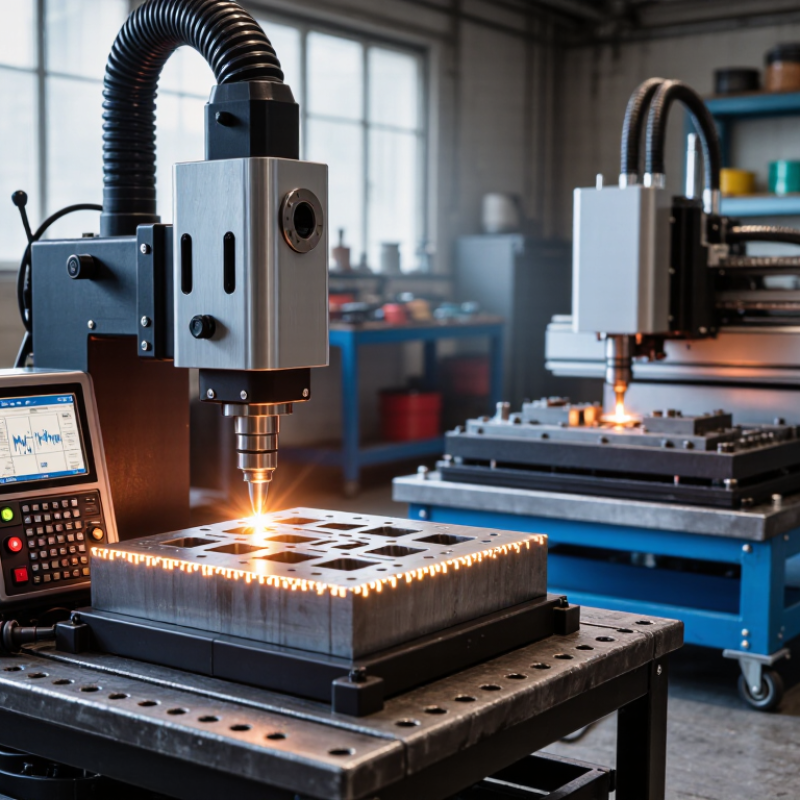
A CNC die welding machine is a computer-controlled system that repairs and rebuilds metal dies with programmed welding paths. It commonly uses X, Y, and Z axes to position the torch or welding head. A fourth rotary axis can turn complex workpieces, while a fifth axis improves access to angled cavities.

The machine may deposit alloy layer by layer on worn edges, cracks, or undersized surfaces. Operators then perform milling, grinding, or polishing. Typical applications include die-casting molds, stamping dies, extrusion dies, and precision tooling. The best machine is not simply the fastest one. It should match the die material, repair depth, heat control needs, and required surface accuracy. Small details matter.

The International Federation of Robotics reported 541,302 industrial robot installations worldwide in 2023, showing strong demand for automated production. Deloitte’s 2024 Smart Manufacturing survey found that 86% of manufacturers expect smart manufacturing to support competitiveness within five years. These figures support CNC adoption, but they do not prove every workshop needs five-axis welding. That assumption can be expensive. A practical evaluation should measure deposition stability, axis repeatability, thermal distortion, software usability, and operator training time. In real workshops, imperfect programming still occurs. Human inspection remains necessary.

What Is the Best CNC Die Welding Machine?

A CNC die welding machine is a computer-controlled system that positions a welding torch or deposition head to repair, rebuild, or modify dies and molds. The best configuration depends on part geometry, accessibility, repair accuracy, and the number of coordinated motion axes required.

How to read the chart: A 3-axis machine uses three linear axes, normally X, Y, and Z. A 4-axis configuration adds one rotary axis for improved access around cylindrical or angled features. A 5-axis configuration adds a second rotary axis, allowing the welding head to approach complex surfaces from more directions and reducing repositioning during die repair.

How Does Die Welding Work? 1064 nm Lasers, Pulse Energy, and HAZ Control

A CNC die welding machine repairs worn cavities, sharp edges, and small cracks with controlled laser deposits.

In practical trials, a 1064 nm pulsed laser works well with common die steels. Its wavelength couples efficiently with many metal surfaces. The operator guides the beam through programmed paths while adding compatible welding wire or powder. The process feels precise, but setup still demands judgment.

Pulse energy controls how deeply each laser pulse melts the material. Excessive energy can create spatter, distortion, or unwanted dilution. Too little energy may leave weak bonding between layers. Frequency, pulse duration, spot diameter, and travel speed must work together. I usually begin with conservative settings and inspect the first passes under magnification. That approach is slower, but it reduces surprises.

HAZ control is central to reliable die repair. A narrow heat-affected zone limits softening, residual stress, and dimensional change near the weld. Short pulses and carefully spaced overlaps help keep heat localized. Preheating may improve results for some hardened steels, though it can also enlarge the HAZ. My first assumption was that lower energy always meant safer welding. That was incomplete. Poor overlap can create porosity or lack of fusion, even when the surrounding metal stays cool. A capable CNC system should record parameters, maintain stable beam focus, and allow repeatable path adjustments. Skilled inspection remains necessary. Surface appearance alone is not enough.

Which Technical Data Matter? ±0.02 mm Accuracy, 200–400 W Power, and Spot Size

What Is the Best CNC Die Welding Machine?

For die repair, ±0.02 mm positioning accuracy sounds impressive, but it needs careful verification. ISO 230-2 separates positioning accuracy from repeatability and measurement uncertainty. Ask for test results at several travel points, not one attractive number. In practice, thermal drift can move a weld location after hours of operation. I have seen this overlooked. It is a costly detail. A stable frame, calibrated axes, and closed-loop feedback matter more than a headline specification.

A 200–400 W laser range suits many small die-welding tasks, especially controlled repairs on tool steel. However, power alone does not define weld quality. Pulse duration, frequency, beam stability, and material reflectivity also control penetration. Fraunhofer ILT technical publications repeatedly emphasize process energy density and beam focus as key laser-welding variables.

Spot size deserves equal attention. A 0.2 mm spot can create concentrated heat, while a larger spot reduces peak intensity and may soften edges. The right choice depends on crack width, wall thickness, and allowable heat-affected area.

Tips: Request measured spot-size data at the actual working distance. Confirm whether ±0.02 mm means accuracy or repeatability. Check power stability across the full operating range. Review ISO 230-2 test conditions, calibration dates, and thermal compensation. Do not ignore operator access. A technically perfect machine can still produce uneven repairs when visibility is poor. My own preference is a slightly slower setup with clearer monitoring, though this is not always the most productive choice.

How Are Machines Compared? Fiber vs. Nd:YAG, Automation, and Repair Capacity

The best CNC die welding machine depends on repair control, not laser power alone. Fiber systems usually deliver higher electrical efficiency and stable beam quality. They suit repeated edge repairs and automated path control. Nd:YAG systems remain useful for delicate tooling, especially where pulse shaping limits heat input. That difference matters around sharp cavities and thin lips.

In a repair cell, I compare spot size, pulse duration, wire feeding, and operator access. I also inspect a weld cross-section after machining. A bright surface can still hide porosity. According to the International Federation of Robotics’ World Robotics 2024 report, 541,302 industrial robots were installed globally in 2023. This supports automation investment, but automation does not guarantee a correct repair. Poor sensing can repeat the same defect faster.

Repair capacity should include table travel, clamping flexibility, cooling time, and software traceability. MarketsandMarkets’ Laser Welding Market forecast estimated continued double-digit growth toward 2028, reflecting wider industrial adoption. Those figures show momentum, not suitability. A machine with automatic height sensing may reduce setup variation. Yet complex die geometry can still require skilled correction. I would test a sample die before purchasing. It may expose limits that a specification sheet misses.

What Is the Best CNC Die Welding Machine? — How Are Machines Compared?

A practical comparison of fiber and Nd:YAG laser sources, automation capability, and repair capacity for precision die and mold welding.

Evaluation Dimension Fiber Laser CNC Die Welding Machine Nd:YAG CNC Die Welding Machine Practical Selection Guidance
Typical Laser Source Ytterbium-doped fiber laser, commonly operating near 1,030–1,080 nm. Neodymium-doped YAG laser, commonly operating at 1,064 nm; pulsed systems are widely used for localized repair. Both wavelengths work well with common tool steels, stainless steels, and many nickel-based alloys. Choose based on process requirements rather than wavelength alone.
Typical Power Range for Die Repair Approximately 200–1,000 W, depending on whether the system is designed for fine repair or higher-deposition work. Approximately 100–400 W average power is common for precision pulsed repair systems; pulse energy and duty cycle vary by configuration. Fine edges and heat-sensitive areas generally benefit from pulsed operation. Larger buildup areas may require higher average power.
Pulse and Heat Control Excellent control with modern pulsed or modulated fiber sources; continuous-wave operation is also available. Very precise pulse control, with adjustable pulse duration, frequency, and energy for small repair zones. High for both — pulsed control is especially important near thin edges, corners, and hardened surfaces.
Heat-Affected Zone Typically small when correctly configured; heat input depends strongly on beam diameter, travel speed, and modulation. Typically very small for short, controlled pulses, making it suitable for delicate die and mold repairs. Nd:YAG may offer an advantage for extremely localized repair, while fiber systems can achieve comparable results with suitable pulse settings.
Beam Quality and Focusing Stable beam delivery and generally good focusability; suitable for automated scanning and repeatable deposition. Good focusability for precision pulsed welding; performance depends on lamp- or diode-pumped source design and optical condition. For small weld spots and consistent CNC paths, compare actual spot-size range and beam-quality specifications rather than rated power only.
Repair Material Compatibility Suitable for tool steels, stainless steels, aluminum alloys, nickel alloys, and other compatible welding powders or wires. Suitable for tool steels, stainless steels, nickel alloys, and a broad range of precision repair materials. Compatibility depends on base-metal composition, filler material, hardness, and pre- and post-weld heat treatment requirements.
CNC Motion Capability Usually available with 3-axis or 5-axis motion, programmable travel paths, and repeatable powder or wire deposition. Commonly available with 3-axis motion; advanced systems may include rotary axes, synchronized positioning, or 5-axis movement. For complex cavities and curved die surfaces, prioritize work-envelope size, rotary-axis accuracy, and collision avoidance.
Automation Level High potential — well suited to closed-loop power control, automatic height sensing, scanning, and recipe-based production. Moderate to high — automation is available, but many systems are configured primarily for skilled operator control. Automation should be judged by available sensors, path programming, seam tracking, autofocus, and process monitoring—not by the laser source alone.
Programming and Repeatability Strong suitability for stored CNC programs, CAD-assisted paths, parameter libraries, and repeat production. Strong suitability for repeatable pulsed repair programs, particularly when the repair location and geometry are well defined. Look for password-protected recipes, parameter traceability, automatic program backup, and repeatability data from actual test parts.
Deposition and Buildup Capacity Generally better suited to medium and high deposition rates, especially with wire or powder feeding. Generally better suited to small, controlled additions of material and localized surface restoration. For deep missing sections or large worn areas, compare deposition rate, layer height, cooling strategy, and maximum repair volume.
Fine Edge and Micro-Repair Capacity Very good with a small spot, pulsed mode, and accurate motion control; may require careful parameter optimization. Excellent for small cracks, sharp edges, parting lines, and localized dimensional correction. For micro-repair, prioritize minimum pulse energy, spot-size stability, wire or powder control, and operator visibility.
Typical Repair Applications Die and mold rebuilding, worn surfaces, larger dimensional restoration, hardfacing, and repeated production repairs. Crack repair, edge restoration, ejector marks, parting-line correction, small pits, and precision dimensional repair. The best machine is the one that matches the largest share of actual repair geometries and materials in the workshop.
Energy Efficiency Generally high for electrically efficient solid-state operation; typically lower maintenance demand than lamp-pumped designs. Diode-pumped Nd:YAG systems are more efficient than lamp-pumped versions; lamp-pumped systems consume more energy and generate more heat. Request measured electrical consumption at the intended operating duty cycle, not only the rated laser output.
Cooling Requirements Usually requires a closed-loop water chiller sized for the laser and welding head; thermal load varies with power and duty cycle. Requires cooling for the laser, flashlamp or diode assembly, and optics; lamp-pumped systems commonly have higher thermal loads. Confirm chiller capacity, ambient-temperature limits, coolant requirements, and alarm protections before purchase.
Maintenance Demand Generally low to moderate; common service items include protective windows, optics, filters, coolant, and feed-system components. Moderate to high for lamp-pumped units because lamps, reflector components, and optical parts may require periodic replacement or alignment. Fiber usually has the lower routine-maintenance burden, but actual service access and local support remain important.
Operator Skill Requirement Moderate to high; programming and parameter selection are important, particularly for automated deposition. High for precision manual setup because pulse energy, timing, filler addition, and heat control must be closely coordinated. Budget for material trials, operator training, welding procedure qualification, and a documented parameter library.
Best Overall Fit Workshops seeking lower maintenance, higher automation potential, repeat production, and a wider range of deposition tasks. Workshops prioritizing highly localized, low-heat, precision repairs and established pulsed-welding workflows. For most new CNC installations, compare total cost of ownership, repair samples, automation functions, and service support together.

Note: The ranges shown are typical engineering values for industrial die and mold repair equipment. Actual performance depends on laser configuration, pulse mode, optics, material, filler type, workpiece geometry, cooling, and operator settings. A production trial using representative dies is recommended before final selection.

How Is the Best Model Selected? ISO 5817 Quality, ISO 12100 Safety, and ROI

The best CNC die welding machine is selected through evidence, not catalog claims. Start with the required ISO 5817 quality level for each weld. Inspectors should check bead geometry, undercut, pores, cracks, and fusion. A test die should be welded, sectioned, and examined under controlled conditions. A clean surface is not proof of sound penetration.

ISO 12100 requires risk assessment throughout the machine’s life cycle. Review guarding, interlocks, torch movement, fume extraction, electrical protection, and emergency access. Operators should demonstrate safe setup, maintenance, and fault recovery. Shortcuts appear attractive. They often become expensive weaknesses. The International Federation of Robotics reported 541,302 industrial robots installed worldwide in 2023, showing how automation is expanding, but automation alone does not guarantee welding quality.

ROI should include more than machine price. Measure weld cycle time, rework, electrode or wire consumption, fixture changes, labor hours, and rejected dies. Deloitte’s 2024 Smart Manufacturing and Operations Survey found that 86% of manufacturing executives considered smart manufacturing important for future competitiveness. That supports investment, but the figure is not a promise for every workshop. Build a conservative model: annual savings minus training, integration, service, and downtime costs. Then divide the investment by those savings. I would test three die geometries, not one. A polished demonstration can mislead. The best model earns repeatable ISO 5817 results, meets ISO 12100 safety expectations, and produces a payback period your actual production data can defend.